Last updated 10 months ago. Our resources are updated regularly but please keep in mind that links, programs, policies, and contact information do change.
- Understanding Your Shield: The Core Principles of the Fourth Amendment
- Your 3-Step Guide to Handling a Police Encounter at Your Door
- When the Warrant Rule Doesn’t Apply: Critical Exceptions
- Quick Guide to Warrant Exceptions at Home
- Warrants Demystified: Search vs. Arrest and the “No-Knock” Controversy
- Search Warrant vs. Arrest Warrant at a Residence
- The Fourth Amendment in the Digital Age
- Know Your Rights, Protect Your Freedom
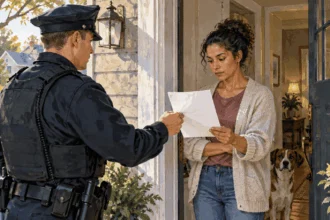
An unexpected knock from a police officer can be an unnerving and stressful experience for anyone. In that moment, questions swirl: What are my rights? What should I say? What am I required to do?
The key to navigating this situation safely and legally lies in understanding a cornerstone of American freedom: the Fourth Amendment to the U.S. Constitution. This amendment serves as a shield, protecting your right to privacy and freedom from unreasonable government intrusions.
It establishes a critical balance between an individual’s right to be secure in their own home and the legitimate needs of law enforcement to ensure public safety.
Understanding Your Shield: The Core Principles of the Fourth Amendment
Before you can effectively use your rights, you must first understand what they are. The Fourth Amendment is the foundation of your privacy protections against government action. Its power lies in clear, yet complex, language forged from a history of colonists resisting intrusive government overreach.
The Text and Its Two Clauses
The Fourth Amendment was ratified on December 15, 1791, and its official text is a single, powerful sentence. Legal scholars often view it as two distinct but related parts: the Reasonableness Clause and the Warrant Clause.
“The right of the people to be secure in their persons, houses, papers, and effects, against unreasonable searches and seizures, shall not be violated, and no Warrants shall issue, but upon probable cause, supported by Oath or affirmation, and particularly describing the place to be searched, and the persons or things to be seized.”
The Reasonableness Clause: The first part, “The right of the people to be secure… against unreasonable searches and seizures, shall not be violated,” establishes the core principle. It does not forbid all searches, only those that are “unreasonable”.
“Reasonableness” is the ultimate constitutional benchmark for any search or seizure. To determine what is reasonable, courts balance the degree of government intrusion on individual privacy against government interests, such as public safety or crime prevention.
The Warrant Clause: The second part, “…and no Warrants shall issue, but upon probable cause…,” sets out the default procedure for making a search reasonable: getting a warrant. This clause requires law enforcement to go before a neutral judge and, under oath, present specific facts that justify the search.
The warrant must also be particular, meaning it has to specify exactly where will be searched and what or who is being sought.
While the amendment seems to create a clear rule—get a warrant—the reality of modern law is more complex. Over decades, the Supreme Court has shifted its focus.
Initially, the court held that warrantless searches were inherently unreasonable, with only a few specific exceptions. However, more recent interpretations have emphasized that “reasonableness” is the “ultimate touchstone” of the Fourth Amendment.
This shift has led courts to create a growing number of exceptions to the warrant requirement. As a result, the “rule” of getting a warrant is now largely defined by the many situations where it doesn’t apply. This makes understanding the exceptions, and your rights when police claim one, more important than ever.
A Shield Forged in History
The Fourth Amendment was not an abstract idea—it was a direct and angry response to the abuses of power experienced by American colonists under British rule. The British Crown used two particularly hated tools:
General Warrants: These documents authorized royal officials to search the belongings of anyone they perceived as a political enemy, without any specific cause or suspicion.
Writs of Assistance: These were essentially open-ended search warrants that allowed officials to enter any home or business to search for untaxed goods, without needing to specify what they were looking for or where they would search.
These practices allowed government agents to intrude into citizens’ private lives with unchecked discretion. The Framers designed the Fourth Amendment’s warrant requirement—with its demand for probable cause and particularity—to explicitly outlaw such arbitrary invasions of privacy and to place the judgment of a neutral magistrate between citizens and police.
Key Concepts Demystified
To understand your rights, you need to understand the language of the Fourth Amendment.
What is a “Search”? The Reasonable Expectation of Privacy: A “search” under the Fourth Amendment is not just police “rummaging through your drawers”. It occurs whenever a government agent intrudes into a space where a person has a “reasonable expectation of privacy”.
The Supreme Court, in the landmark case Katz v. United States, established a two-part test to determine if this expectation exists:
- The person must have an actual, subjective expectation of privacy
- That expectation must be one that society is prepared to recognize as “reasonable”
This is why your home is considered the most protected space—you have a high expectation of privacy there. In contrast, things you “knowingly expose to the public,” even inside your home (like items visible through an open window from the street), are generally not protected.
What is a “Seizure”? A seizure is when the government takes control of something. This can be a “seizure of property,” meaning a meaningful interference with your possessory interests in your belongings, or a “seizure of persons,” which is an arrest.
What is “Probable Cause”? Probable cause is the standard of proof police must meet to get a warrant. It is a reasonable belief, based on reliable facts and information, that a crime has been committed or that evidence of a crime will be found in the place to be searched.
It requires more than a mere hunch or suspicion but is a lower standard than the “beyond a reasonable doubt” needed for a criminal conviction. To get a warrant, an officer must submit an affidavit (a sworn statement) to a judge, laying out the facts that establish probable cause.
Your 3-Step Guide to Handling a Police Encounter at Your Door
Knowing the theory is one thing; applying it in a high-stress moment is another. This practical guide provides clear, actionable advice for what to do when police are at your door. The core principle is to remain calm, be polite, and clearly assert your rights with your words, not with physical actions.
Step 1: Assess and Communicate Before Opening the Door
Your first actions—or inactions—are critical. You control the threshold of your home, and you should not give up that control without good reason.
Stay Calm and Don’t Open Blindly
It is a conditioned reflex to open the door when someone knocks, but in this situation, it is a terrible idea. Take a deep breath and avoid reacting immediately.
Use a peephole, a side window, or a video doorbell to identify who is there. You are not legally obligated to open your door for a police officer unless they have a warrant. Refusing to answer might be the smartest and safest move.
Communicate Through the Closed Door
You can and should communicate without opening the door. Speaking clearly through the closed door, you can ask, “Who is it?” and “How can I help you?”
This allows you to engage with the officers while maintaining the physical barrier of your door, which is your strongest legal protection.
If You Choose to Open, Crack It
If you determine it is necessary to open the door, do not swing it wide open. Use a chain lock if you have one and open it only a crack.
Keep your body mostly behind the door and, crucially, keep your hands visible and at your sides. This prevents any sudden movements that an officer could perceive as threatening.
Step 2: Interact and Assert Your Rights at the Threshold
Once communication is established, your words become your most important tool. You must be clear, calm, and firm in asserting your rights.
Ask for the Reason for Their Visit
Politely ask the officers why they are there. They could be investigating a crime in the neighborhood, warning residents of a danger, or conducting a welfare check on a neighbor, none of which may involve you.
Ask the Critical Question: “Do you have a warrant?”
This is the single most important question you can ask.
If they say YES, you should respond, “Please slide it under the door or hold it up to the window so I can read it.” Do not open the door to take it from them.
If they say NO, you are not required to let them in, and you should not.
The Magic Words: Refusing Consent
If police do not have a warrant, they need your consent to enter. They will likely ask for it. You must clearly, calmly, and verbally refuse permission. Use simple, unambiguous phrases:
- “Officer, I do not consent to a search of my home.”
- “I do not give you permission to enter my property.”
Your rights are not self-enforcing; they must be actively invoked. Silence can be interpreted as consent. Giving consent waives your Fourth Amendment protections for that interaction.
By verbally stating your refusal, you are creating a clear record that will be crucial if the legality of the encounter is ever challenged in court. This proactive step is the first and most important part of your own legal defense.
Stay Inside Your Home
Officers may ask you to step outside to talk. You should politely decline with a phrase like, “I’m comfortable speaking right here, thank you.”
Stepping outside your home moves you from a highly protected private space into a public one, which can diminish your Fourth Amendment protections and gives up the tactical advantage your home provides.
Handling Police Tactics
If police say, “If you don’t let us in, we’ll just go get a warrant,” your response should be, “You are free to do that, officer, but I do not consent to a search.” If they truly had enough evidence for a warrant, they likely would have gotten one before coming to your door.
Do not be swayed by statements like, “If you have nothing to hide, you won’t mind if we look around.” Your constitutional right to privacy is absolute and not conditional on your innocence.
Never Use Physical Force
This cannot be overstressed. Never physically resist an officer, slam the door on their hand or foot, or try to block their entry. This is incredibly dangerous and will likely lead to your arrest on new charges like resisting arrest or assault on an officer, regardless of the legality of their entry.
Use your words to object, not your body. The place to fight an illegal entry is in court, not at your doorway.
Step 3: Document and Follow Up During and After the Encounter
If police do enter your home—either with a valid warrant or under a claimed exception—your rights do not disappear. Your role now shifts to that of a silent observer and record-keeper.
Invoke Your Right to Remain Silent
Once police are inside, you must assert your Fifth Amendment right. State clearly and calmly, “I am exercising my right to remain silent, and I wish to speak with a lawyer.”
After you say this, stop talking. Do not answer questions, make small talk, or offer explanations. Police are legally permitted to lie to you to get you to incriminate yourself. Anything you say can and will be used against you.
Record Everything (Safely)
If it is safe to do so, record the entire interaction on your phone or a home security camera. If your phone is not in your hand, you can use a voice command like “Hey Siri, record!”
Do not make sudden movements for your phone; always keep your hands where officers can see them. A recording provides an objective account of the events.
Observe and Document
While police are searching, do not interfere, but be a meticulous observer. Watch where they go, what they look at, and what they take.
As soon as they leave, write down everything you remember in as much detail as possible. Note the officers’ names and badge numbers, their agency, the time of the encounter, exactly what was said, and a comprehensive list of every item seized.
If you were injured, seek medical attention immediately and take photographs of your injuries.
Contact an Attorney
As soon as you are able, contact a criminal defense attorney. This is especially critical if you have been arrested or believe your rights have been violated.
An attorney can advise you on the next steps and begin building a defense based on the facts of the encounter.
When the Warrant Rule Doesn’t Apply: Critical Exceptions
A key part of protecting your rights is understanding the situations where police are not required to have a warrant to enter your home. These are known as “exceptions to the warrant requirement.” Believing the warrant rule is absolute can lead to a dangerous misjudgment of a situation.
Consent
This is the most frequent exception. If you voluntarily give police permission to enter or search, you have waived your Fourth Amendment protection. This consent can also be given by another person who has the authority to do so, such as a roommate who shares the common areas of an apartment.
For consent to be valid, it must be given voluntarily and not as a result of threats, intimidation, or an officer falsely claiming they have a warrant when they do not.
Exigent Circumstances (Emergencies)
This exception applies to situations where the time it would take to obtain a warrant would result in imminent danger, the destruction of evidence, or the escape of a suspect. The circumstances must be genuinely urgent.
Hot Pursuit: This allows police to follow a fleeing felon into a private residence without a warrant. The pursuit must be immediate and continuous. This exception does not apply to minor offenses (misdemeanors).
Imminent Destruction of Evidence: If police have probable cause to believe that evidence is actively being destroyed inside, they may be able to enter. A classic example is police knocking, announcing their presence, and then hearing sounds consistent with drugs being flushed down a toilet.
However, police are not allowed to create the exigency themselves by engaging in or threatening to engage in conduct that violates the Fourth Amendment.
Emergency Aid / Community Caretaking: If police have an objectively reasonable basis to believe that someone inside is seriously injured or in imminent danger of being harmed, they can enter to provide assistance.
Examples include hearing screams for help, reports of shots fired, or seeing a violent altercation through a window. The purpose of the entry must be to render aid, not to conduct a general search for evidence.
Plain View Doctrine
This doctrine allows police to seize evidence without a warrant if three conditions are met:
- The officer is legally in the location from which the item can be viewed
- The item is in plain sight
- The incriminating character of the item is “immediately apparent”
For example, if police are lawfully inside your home to execute a search warrant for a stolen laptop and they see illegal drugs on the coffee table, they can seize the drugs.
Search Incident to a Lawful Arrest
If police lawfully arrest someone inside a home, they are permitted to conduct a warrantless search of the arrested person and the area within their immediate control—often called their “wingspan” or “arm’s reach.”
The purpose is to prevent the arrestee from grabbing a weapon or destroying evidence.
Quick Guide to Warrant Exceptions at Home
| Exception | What It Means | Police Must Believe… | Example |
|---|---|---|---|
| Consent | You or an authorized person voluntarily agrees to the search. | N/A (Permission is given) | You say, “Yes, officer, you can come in and look around.” |
| Exigent Circumstances: Hot Pursuit | Police are actively chasing a fleeing felon. | Probable cause that a serious crime was committed and the suspect is fleeing. | Officers chase a bank robbery suspect who runs into his own house. |
| Exigent Circumstances: Destruction of Evidence | Evidence of a crime is about to be destroyed. | Probable cause that evidence is present and its destruction is imminent. | After knocking, police hear a toilet repeatedly flushing and people shouting about getting rid of “the stuff.” |
| Exigent Circumstances: Emergency Aid | Someone inside is in immediate danger of serious harm. | An objectively reasonable basis that a person needs immediate medical aid or is in danger. | A 911 caller reports hearing screams and sounds of a violent fight coming from next door. |
| Plain View | Incriminating evidence is visible from a legal vantage point. | The officer is lawfully present and the item’s illegal nature is immediately obvious. | Police executing an arrest warrant see a bag of cocaine on the kitchen table. |
| Search Incident to Lawful Arrest | A search conducted at the time of a lawful arrest. | The arrest is lawful. | After arresting a person in their living room, police search the couch cushions where the person was sitting. |
Warrants Demystified: Search vs. Arrest and the “No-Knock” Controversy
If police do claim to have a warrant, it is vital to understand what kind of warrant it is and what authority it grants them. Not all warrants are the same, and the differences are critical.
Search Warrants vs. Arrest Warrants: What’s the Difference?
When an officer presents a document, you need to know what you’re looking at. The two most common types are search warrants and arrest warrants, and they authorize very different actions.
Search Warrant
A search warrant is a court order authorizing law enforcement to search a specific place for specific things. The Fourth Amendment’s “particularity requirement” is key here.
The warrant must describe with detail the address to be searched and the evidence or contraband to be seized. This means police with a warrant to search for a stolen television cannot start rummaging through your desk drawers or medicine cabinet, as the TV could not reasonably be hidden there.
Arrest Warrant
An arrest warrant is a court order authorizing law enforcement to take a specific person into custody.
At the Suspect’s Home: If police have an arrest warrant for you and have a “reason to believe” you are inside your own home, they can legally enter to arrest you.
Limited Search Authority: An arrest warrant alone does not give police the authority to conduct a full search of your home. They can look in spaces where a person might be hiding, and they can seize any evidence they see in plain view. After the arrest, they can also perform a “search incident to arrest” of the area within your immediate control.
At a Third Party’s Home: To arrest a suspect at someone else’s house (e.g., a friend’s or relative’s), police generally need two documents: an arrest warrant for the suspect and a search warrant for the third party’s home.
Search Warrant vs. Arrest Warrant at a Residence
| Warrant Type | Purpose | Authorizes Entry? | Authorizes Search? | What to Check on the Document |
|---|---|---|---|---|
| Search Warrant | To find and seize specific evidence of a crime. | Yes, for the specific location listed. | Yes, but only in places where the specified items could reasonably be found. | The correct address; judge’s signature; a specific list of places to be searched and items to be seized. |
| Arrest Warrant | To take a specific person into custody. | Yes, if it is the suspect’s own home and police believe they are inside. | No, not a full search. Only a “protective sweep” for the person and a “search incident to arrest” of the immediate area around the person. | The name of the person to be arrested; judge’s signature. |
The “No-Knock” Warrant Controversy
A particularly contentious issue in modern policing is the use of “no-knock” warrants.
What It Is
A no-knock warrant is a special type of search warrant that gives police judicial permission to enter a property by force without first knocking and announcing their presence and purpose.
The traditional “knock-and-announce” rule is considered part of the Fourth Amendment’s reasonableness inquiry, intended to prevent violence, protect property, and uphold privacy.
The Legal Standard
A judge can issue a no-knock warrant if police demonstrate a “reasonable suspicion” that knocking and announcing would be dangerous (e.g., the suspect is known to be armed and violent), futile, or would allow for the quick destruction of evidence.
The Controversy and Risks
The use of no-knock raids has exploded, increasing from an estimated 1,500 per year in the early 1980s to as many as 80,000 in recent years, often for low-level drug searches.
Critics argue these raids create chaotic, dangerous, and often deadly situations. When armed officers use a battering ram to break down a door, often in the middle of the night, startled residents may believe they are the victims of a home invasion and react in self-defense, leading to tragic outcomes.
The high-profile deaths of Breonna Taylor in Kentucky and Amir Locke in Minneapolis during the execution of no-knock warrants have brought intense scrutiny to the practice.
Reform Efforts
In response to these tragedies, several states have moved to ban or restrict no-knock warrants. At the federal level, President Biden issued an executive order limiting their use by federal law enforcement agencies, and legislation like the “Amir Locke End Deadly No-Knock Warrants Act” has been introduced in Congress to impose national restrictions.
The Fourth Amendment in the Digital Age
The Framers could never have imagined a world of smartphones and the internet, yet the principles they enshrined in the Fourth Amendment are constantly being tested and applied to new technologies. The core question remains the same: what is a “reasonable expectation of privacy” in an era where our most intimate “papers and effects” are digital?
Your Digital “Effects”: Cell Phones and Computers
In the landmark 2014 case Riley v. California, the Supreme Court unanimously held that police generally need a warrant to search the digital contents of a person’s cell phone, even after a lawful arrest.
The Court recognized that modern smartphones contain the “privacies of life” and are not comparable to the physical items a person might carry in their pockets. Searching a phone can reveal vast quantities of personal information, including emails, photos, location history, and internet browsing data, making a warrantless search a profound invasion of privacy.
Electronic Surveillance: New Frontiers of Searching
The government’s ability to collect vast amounts of electronic data has created new and complex Fourth Amendment challenges.
GPS Tracking and the “Mosaic Theory”
In United States v. Jones (2012), the Supreme Court ruled that attaching a GPS tracker to a suspect’s car and monitoring its movements for an extended period (28 days in that case) constituted a “search” requiring a warrant.
This case helped popularize the “mosaic theory” of the Fourth Amendment. This theory holds that even if individual data points (like a car’s location at one moment in time) are public, collecting a vast number of those points over time creates a “mosaic” that reveals a detailed and private picture of a person’s life, associations, and habits.
This cumulative surveillance can violate a reasonable expectation of privacy, even if each individual step does not.
“Reverse Keyword” Warrants
One of the most cutting-edge legal battles involves “reverse keyword” or “keyword search” warrants. Instead of identifying a suspect and then seeking to search their property, these warrants work in reverse.
Law enforcement, having evidence of a crime, can obtain a warrant compelling a company like Google to provide the personal information of every user who searched for a specific keyword or phrase (e.g., the address of an arson, the name of a victim) during a certain time frame.
Civil liberties advocates argue these are the digital equivalent of the unconstitutional “general warrants” the Fourth Amendment was written to prevent. They are not based on probable cause regarding a specific person but are “dragnet” searches that can sweep hundreds or thousands of innocent people into a criminal investigation based on nothing more than their private thoughts and online queries, chilling free speech and violating privacy.
Courts are currently grappling with whether these warrants violate the particularity and probable cause requirements of the Fourth Amendment, signaling that the fight to define privacy in the digital age is far from over.
Know Your Rights, Protect Your Freedom
The Fourth Amendment stands as one of the most important protections against government overreach in American law. When police come to your door, your response in those crucial first moments can make the difference between preserving your constitutional rights and inadvertently waiving them.
Remember the key principles:
- You are not required to open your door unless police have a warrant
- Clearly state that you do not consent to any search
- Stay inside your home to maintain maximum protection
- Never physically resist but assert your rights verbally
- Document everything if police do enter
- Contact an attorney immediately if your rights have been violated
The Fourth Amendment is not just words on paper—it’s a living protection that requires your active participation to remain effective. By understanding your rights and knowing how to assert them calmly and clearly, you help preserve the constitutional principles that protect all Americans from unreasonable government intrusion.
In an era of expanding surveillance capabilities and evolving law enforcement tactics, the Fourth Amendment’s protections are more vital than ever. Your home remains your castle, but only if you know how to defend it.
Our articles make government information more accessible. Please consult a qualified professional for financial, legal, or health advice specific to your circumstances.