Last updated 10 months ago. Our resources are updated regularly but please keep in mind that links, programs, policies, and contact information do change.
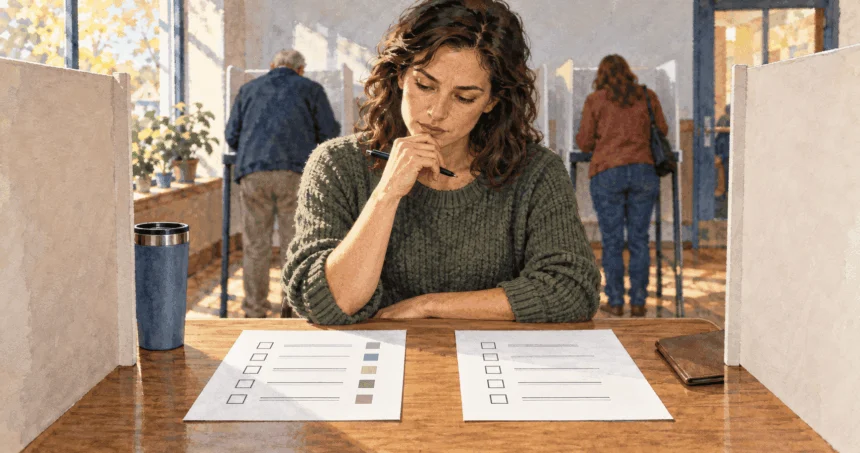
When you walk into a voting booth, the structure of your ballot has already been decided for you. Some candidates appear with party labels like “Democrat” or “Republican” next to their names. Others stand alone without any party designation.
This seemingly simple difference—whether candidates are identified by political party—fundamentally shapes American democracy in ways most voters never realize.
- Partisan Elections: When Party Labels Lead
- Nonpartisan Elections: Removing the Labels
- Table 1: Examples of Partisan and Nonpartisan Offices in the U.S.
- Historical Roots: Why We Have Both Systems
- How Election Types Shape Democracy
- Table 2: Partisan vs. Nonpartisan Elections: A Quick Comparison
- The Debate: Weighing Trade-offs
- Contentious Arenas: Where the Debate Gets Heated
- Finding Your Election Information
- The Bigger Picture
The presence or absence of party labels affects who runs for office, how people vote, and ultimately how government operates. Understanding this distinction empowers you to navigate elections more effectively and recognize the forces shaping your choices before you even cast a vote.
Partisan Elections: When Party Labels Lead
What Makes an Election Partisan
A partisan election is one where candidates appear on the ballot with explicit political party affiliations—Democrat, Republican, Libertarian, Green, or others. This label means the candidate has been nominated by that party or is officially recognized by it.
State laws typically formalize these requirements. In Florida, for example, partisan candidates must file written statements identifying their political party and affirming they’ve been registered members for at least 365 days before the qualifying period. Candidates with no party affiliation must state they haven’t been registered with any party for the preceding 365 days.
The Hatch Act, which governs political activities of government employees, provides another definition. Under this federal law, an election is partisan if any candidate represents a political party whose presidential candidates received votes in the most recent presidential election. This includes major parties like Democrats and Republicans, plus smaller parties like Libertarians and Greens.
Importantly, an election is considered partisan even if only one candidate represents a political party while others don’t.
The Path to Nomination
Getting nominated as a party candidate involves processes largely controlled by political parties themselves, since they’re private organizations. While federal and state laws set boundaries—particularly around voting rights and campaign finance—the nomination mechanics are primarily internal party affairs.
Primary Elections are the most common method. These preliminary contests allow voters to choose the party’s candidates for the general election. Primaries can be “closed,” meaning only registered party members can participate, potentially excluding large numbers of voters. Or they can be “open,” allowing any registered voter to cast a ballot in any one party’s primary.
Caucuses involve meetings of registered party members at local levels where they discuss candidates, debate issues, and vote to select delegates or express candidate preferences. These require more time commitment than simply casting a primary ballot.
Conventions at local, state, and national levels formally nominate candidates. These often serve as culminating events where delegates selected through primaries or caucuses officially designate the party’s nominee.
Where You’ll Find Partisan Elections
Partisan elections dominate at federal and state levels:
Federal offices include the President and Vice President, plus all members of Congress—the Senate and House of Representatives.
State offices typically include governors, state legislators (with one notable exception), attorneys general, secretaries of state, and other statewide positions.
Local offices vary significantly. Some municipal, county, and special district positions use partisan elections. In Washington state, most county-level positions like commissioner, assessor, auditor, clerk, sheriff, and treasurer are partisan contests, except for judges.
Nonpartisan Elections: Removing the Labels
What Defines Nonpartisan
Nonpartisan elections are characterized by the absence of political party labels next to candidates’ names on the ballot. Candidates are listed without any indication of party affiliation or party designation.
The Hatch Act defines nonpartisan elections as those where no candidate represents a political party whose presidential candidates received votes in the last presidential election. However, an election designated as nonpartisan under state or local law might still be considered partisan for Hatch Act purposes in specific circumstances.
The theory behind nonpartisan elections is shifting voter focus away from party labels toward individual candidate merits, qualifications, and policy positions. The goal is encouraging more direct assessment of who’s best suited for office, independent of broader party platforms.
In practice, this ideal encounters various political realities. Voters accustomed to using party affiliation as an information shortcut may find it more challenging to evaluate candidates without this cue. This can lead to greater reliance on other factors like name recognition or attempts to discern unofficial partisan indicators.
The Nonpartisan Path
Nomination processes in nonpartisan elections differ significantly from partisan counterparts since they operate without formal party involvement in selecting who appears on the general election ballot.
Nonpartisan Primaries feature all candidates competing against each other in a single primary election, regardless of personal party affiliations they might hold. Crucially, all eligible voters can participate regardless of their own party registration or lack thereof.
Top-Two Systems are common features of nonpartisan primaries. The two candidates receiving the highest vote totals advance to the general election, regardless of party preference or affiliation. This means two candidates from the same party could face each other in the general election.
California uses a “Top-Two Primary” system for statewide executive offices, state legislative seats, and congressional races. Washington state also utilizes top-two primaries, which the Supreme Court deemed constitutional in Washington State Grange v. Washington State Republican Party (2008).
Candidate “Preference” Statements in some systems allow candidates to state party preferences on ballots (like “Prefers Democratic Party”). However, this merely indicates candidate preference and doesn’t imply official party nomination, endorsement, or approval.
Where Nonpartisan Elections Appear
Nonpartisan elections are prevalent across the United States, particularly for offices emphasizing local concerns, specialized expertise, or perceived neutrality.
Municipal and County Offices like mayor and city council members, plus various county-level roles, often use nonpartisan elections.
School Boards represent one of the most common nonpartisan areas. Over 90% of the nation’s 13,187 public school districts use nonpartisan elections for their 83,183 school board members. State laws in 41 states specifically provide for nonpartisan school board elections.
Judicial Elections commonly use nonpartisan formats for selecting state court judges. As of 2025, 13 states used nonpartisan elections for state supreme court positions, and 19 states employed this method for at least one lower court type.
Nebraska’s Unique System: Nebraska elects its state legislators through nonpartisan elections and maintains the nation’s only unicameral (single-chamber) state legislature. While officially nonpartisan, many members have known major party affiliations, and parties often endorse candidates.
Table 1: Examples of Partisan and Nonpartisan Offices in the U.S.
| Feature | Partisan Elections | Nonpartisan Elections |
|---|---|---|
| Ballot Appearance | Candidate’s political party label (e.g., Democrat, Republican) is displayed | No political party label is displayed next to the candidate’s name |
| Typical Offices | U.S. President, U.S. Congress, Governor, Most State Legislatures, Many County Offices | City Council, Mayor (in many cities), School Board, Judges, Nebraska State Legislature |
| Primary Election Type | Party-specific primaries (open or closed), caucuses, conventions | All candidates compete in a single primary; often top-two advance |
Historical Roots: Why We Have Both Systems
The coexistence of partisan and nonpartisan elections in America reflects distinct historical developments and philosophical debates about democratic governance.
The Long Tradition of Partisan Politics
The United States has deep roots in partisan elections, particularly for executive and legislative offices. From the republic’s early days, political factions and later organized parties emerged as primary vehicles for contesting elections, mobilizing voters, and organizing governmental power.
This system became foundational to American political structures, shaping how policies are debated, formulated, and implemented. The concept of a “loyal opposition” and peaceful power transfers between competing party-based groups became hallmarks of this tradition.
Progressive Era Reforms
The widespread adoption of nonpartisan elections for certain offices, especially at local levels, largely emerged from the Progressive Era—a period of intense social and political reform from the late 19th to early 20th century.
This movement arose significantly as a reaction against perceived negative consequences of dominant “party machine” systems in many large cities and counties. These party organizations faced criticism for corruption, cronyism, and prioritizing partisan interests over public good and efficient governance.
Progressive reformers advocated nonpartisan elections with several key objectives:
Reducing Corruption and Patronage: By removing party labels and weakening party boss control over nominations and elections, reformers sought to diminish opportunities for corrupt practices and distributing government jobs based on political loyalty rather than merit.
Increasing Voter Choice: They hoped nonpartisan elections would encourage wider arrays of individuals to run for office, particularly those less inclined toward strong party affiliation or focused on specific expertise.
Improving Government Efficiency: Reformers believed applying “businesslike” principles to government administration would lead to greater efficiency and effectiveness. A popular saying of the era held that there is no Republican or Democratic way to pave a street or lay a sewer, capturing the sentiment that many local functions should be administrative and technical, not subject to partisan battles.
Encouraging More Informed Voters: The theory held that removing the “shortcut” of party labels would compel voters to seek more detailed information about individual candidates’ qualifications and issue positions.
Judicial elections were among the earliest nonpartisan reform targets, grounded in principles that judges should be impartial law arbiters, insulated from political pressures.
These reforms proved quite effective—today, more than half of all local election races in the U.S. are conducted on a nonpartisan basis.
How Election Types Shape Democracy
The decision to conduct elections as partisan or nonpartisan creates cascading effects, influencing how voters receive information and make choices, what types of individuals run for office and how they campaign, and ultimately, government functioning and outcomes.
The Voter Experience
Information and Shortcuts: In partisan elections, party labels serve as significant “informational shortcuts” for many voters. These labels quickly convey general senses of candidates’ ideologies, policy preferences, and alignment with broader political platforms, potentially simplifying voting decisions for voters with limited time or detailed candidate knowledge.
In nonpartisan elections, absent party labels mean voters must rely on other information sources to differentiate between candidates. While Progressive Era reformers hoped this would lead voters to seek more substantive information, research suggests this isn’t always the case. Instead, voters might turn to secondary cues like name recognition, community group endorsements, or media coverage.
Voter Turnout Differences: Political science research shows voter turnout tends to be lower in nonpartisan elections compared to partisan contests—sometimes by around 10 percentage points on average. Psychological attachment to political parties and party mobilization efforts are considered factors motivating participation in partisan elections.
However, nonpartisan primary systems like top-two primaries can sometimes increase voter participation by allowing broader electorate segments, including independent voters, to participate in crucial first-stage elections.
Voter Confidence: Studies indicate voters often report feeling less confident in voting decisions when partisan cues are absent from ballots. Party labels can provide familiarity and predictability, even if broadly generalized.
Conversely, while party identification can motivate engagement, very strong partisan identity sometimes hinders voters’ openness to critically evaluating all candidates, including those from opposing parties or running without party labels.
The Candidate Experience
Who Runs and Why: Election system nature can influence what types of individuals decide to become candidates. Some potential candidates whose views may not align perfectly with major political party platforms might be discouraged from running in partisan races where securing party nominations is essential.
Nonpartisan elections theoretically create more welcoming environments for broader candidate ranges. Individuals focusing on specific local issues, professional qualifications, or more independent governance approaches might find nonpartisan contests more appealing.
Campaign Finance Dynamics: Political parties often play significant roles in funding and supporting candidates in partisan elections, providing financial contributions, organizational infrastructure, volunteer networks, and campaign management expertise.
In nonpartisan elections, where direct party support is officially absent, candidates may need to rely more heavily on personal wealth, individual donations, or non-party interest group support. Some research suggests nonpartisan elections might inadvertently favor wealthier candidates who can better afford building name recognition without party label assistance.
However, the campaign finance landscape in nonpartisan settings is evolving. Analysis suggests that “all-candidate” nonpartisan primaries like top-two systems may actually reduce outside spending influence by ideological special interest groups by as much as two-thirds compared to traditional partisan primaries.
Incumbency Advantage: Nonpartisan elections tend to amplify advantages held by incumbents. When party labels are removed as primary voting cues, voters often fall back on name familiarity. Incumbents generally possess stronger name recognition than challengers, making it more difficult for challengers to gain traction in nonpartisan races.
Governance Impact
Political Polarization: Partisan elections can sometimes contribute to increased political polarization in governing bodies. Elected officials may feel pressure to adhere to party lines or prioritize party agendas over local needs, especially if they anticipate primary challenges from within their own parties.
Nonpartisan systems are often advocated as means to reduce such polarization and foster more cooperative governing environments. The idea is that without constant party allegiance pressure, elected officials might be more inclined to work across ideological divides and make merit-based decisions.
However, nonpartisan elections’ effectiveness in reducing polarization isn’t always guaranteed. Some research on school boards found that members elected in nonpartisan systems can still exhibit significant polarization, possibly because lacking party labels to signal views, candidates may feel greater need to clearly articulate ideological positions during campaigns.
Accountability Mechanisms: In partisan systems, political parties can serve as collective accountability mechanisms. Voters can reward or punish parties based on perceived performance of elected officials and policy agenda success or failure.
In nonpartisan systems, accountability tends to be more individualized. Each elected official stands more directly responsible primarily to their constituents for their actions.
Policy Outcomes: Election system types can have tangible effects on policy decisions and government operations. A study of North Carolina school boards that transitioned from nonpartisan to partisan elections found several notable changes: districts making the switch experienced reductions in per-pupil spending, higher teacher turnover rates, and increases in less experienced teacher proportions.
The same study indicated that shifting to partisan elections reduced likelihood of Democratic candidates or non-white candidates winning school board elections.
Table 2: Partisan vs. Nonpartisan Elections: A Quick Comparison
| Feature | Partisan Elections | Nonpartisan Elections |
|---|---|---|
| Ballot Appearance | Candidate’s political party label (e.g., Democrat, Republican) is displayed | No political party label is displayed next to the candidate’s name |
| Candidate Nomination | Typically through party primaries, caucuses, or conventions | Often through a nonpartisan primary where all candidates compete; top vote-getters (e.g., top two) advance to the general election |
| Primary Focus for Voters | Party affiliation often serves as a key informational cue | Candidate’s individual qualifications, experience, and stance on issues are intended to be the focus |
| Typical Offices | U.S. President, U.S. Congress, Governor, Most State Legislatures, many county offices | Many municipal offices (mayor, city council), school boards, judicial positions, Nebraska State Legislature |
| Voter Turnout (General Trend) | Generally tends to be higher | Generally tends to be lower than in partisan elections |
| Potential for Polarization | Can be higher, as candidates and officials may align closely with party platforms | Aims to be lower, encouraging focus on common ground and local issues |
| Key Pro Argument Example | Provides clear ideological signals to voters and allows for party accountability | Encourages focus on individual merit and qualifications, potentially reducing divisive partisanship |
| Key Con Argument Example | May lead officials to prioritize party loyalty over local needs or broader public interest; can exclude non-affiliated voters from primaries | Voters may lack clear informational cues, potentially leading to lower turnout or reliance on name recognition; partisanship may still exist covertly |
The Debate: Weighing Trade-offs
The choice between partisan and nonpartisan elections involves weighing competing values and considering specific office contexts.
The Case for Partisan Elections
Transparency and Information: Party labels offer voters clear, readily understandable signals about candidates’ general political leanings, ideological orientations, and likely policy stances. Knowing a candidate is a Democrat or Republican can help predict voting patterns on controversial issues.
Party Accountability: Partisan systems allow voters to hold political parties collectively accountable for elected officials’ performance and platform outcomes. The structure of majority party governing while organized minority parties provide checks and balances is seen as a two-party system strength.
Mobilization and Turnout: Political parties often invest significant resources in voter registration drives, get-out-the-vote efforts, and general political education. This activity, combined with party identification’s motivational aspects, generally leads to higher voter turnout in partisan elections.
Candidate Vetting: Parties can play roles in recruiting and vetting candidates, potentially leading to more qualified or thoroughly examined contender fields before reaching general electorates.
Political Reality: In an era of increasing issue politicization, some argue that having partisan elections for offices like school boards or local councils simply reflects existing political divisions logically and allows these debates to occur more openly.
The Case for Nonpartisan Elections
Individual Merit Focus: Nonpartisan elections encourage voters to look beyond party affiliation and assess candidates based on individual merits, experience, character, and specific relevant issue stances.
Reduced Polarization: Nonpartisan systems aim to lessen partisan conflict and gridlock in governing bodies. By downplaying party identity, elected officials may be more inclined to cooperate, compromise, and focus on problem-solving rather than partisan battles.
Broader Candidate Appeal: These systems may attract more diverse candidate pools, including those not wishing to align with major political parties or whose views are more independent. They ensure all voters, including those not registered with major parties, can fully participate in primary elections.
Local Focus: Particularly for local offices like school boards or city councils, nonpartisan elections help keep focus on specific community needs and local issues rather than having decisions dictated by national party agendas.
Corruption Reduction: Historically, a primary motivation for adopting nonpartisan elections was curbing political party machine power and reducing associated corruption and patronage.
Contentious Arenas: Where the Debate Gets Heated
While the partisan versus nonpartisan question applies to many offices, the debate is particularly intense for certain election types, notably judicial and school board contests.
Judicial Elections: Independence vs. Accountability
Traditional rationale for using nonpartisan elections to select judges is rooted in ideas that judges should be neutral law arbiters, standing above partisan political fray. Many states utilize nonpartisan ballots for judicial positions at various court levels.
However, recent decades have witnessed significant increases in judicial election politicization, whether nominally partisan or nonpartisan. These contests increasingly feature substantial campaign spending, active special interest group involvement, and sometimes aggressive advertising campaigns.
This trend raises serious concerns about judicial independence and maintaining public trust in the judiciary. There’s widespread perception and some empirical evidence suggesting campaign contributions and partisan pressures might influence judicial decision-making.
The Brennan Center for Justice tracks and reports on these issues, noting escalating costs and politicization of state supreme court races.
School Board Elections: Local vs. National Politics
Historically, the vast majority of public school boards in the U.S. have been elected through nonpartisan contests. The primary rationale has been keeping school governance focus on local educational needs, student well-being, and community priorities rather than entangling public education in broader partisan conflicts.
Recently, however, there’s been growing movement and intensified debate in several states about making school board elections partisan. A notable example is proposed constitutional amendments in Florida that would require district school board members to be elected in partisan elections.
Arguments for maintaining nonpartisan school board elections include:
Inclusive Participation: Nonpartisan primaries allow all registered voters, regardless of party affiliation, to participate in candidate selection.
Local Control: Decisions are more likely based on specific local school district needs rather than dictated by state or national party agendas.
Diverse Perspectives: Nonpartisanship fosters school community environments welcoming to diverse viewpoints, potentially attracting broader ranges of qualified board candidates.
Arguments for making school board elections partisan include:
Increased Transparency: Candidate party affiliation can provide voters clearer indications of underlying ideologies and voting patterns on contentious educational issues.
Political Reality Reflection: Public education has already become highly politicized, with significant ideological differences reflected in legislation, making partisan labels logical extensions.
Alignment with Other Races: Making school board elections partisan would align them with other local elected offices like county commissioners or sheriffs.
Research from North Carolina on switching to partisan school board elections suggests potential negative consequences, including per-pupil spending reductions, increased teacher turnover, and adverse effects on elected candidate diversity.
Finding Your Election Information
Understanding whether your local elections are partisan or nonpartisan is crucial for informed voting. The most reliable source for election structure information is your official state or local election office.
Key Resources
Official Election Offices: State and local election office websites typically provide details on upcoming elections, including sample ballots showing exactly how candidates are listed—with or without party affiliations. The federal government portal USA.gov offers convenient ways to find contact information and websites for election offices nationwide.
Vote.gov: This official U.S. government website serves as a central hub for election information, providing guidance on voter registration, checking registration status, finding polling places, and understanding basic voting procedures.
Ballotpedia: This nonpartisan, nonprofit online encyclopedia provides detailed information on federal, state, and local candidates, election rules, ballot measures, and elected office specifics.
League of Women Voters: This nonpartisan organization has been empowering voters for over a century. Their VOTE411.org website provides personalized voting information, including nonpartisan candidate guides, ballot measure information, and polling place lookup tools.
Local News and Candidate Websites: Local newspapers, television stations, and reputable online news sources often provide local election and candidate coverage. Candidate websites can also provide platform and priority information.
The Bigger Picture
Whether an election features party labels or not shapes more than just ballot appearance—it influences the entire democratic process. From who decides to run for office to how voters make decisions to how government operates afterward, the partisan or nonpartisan structure creates different democratic experiences.
Understanding these systems empowers you to navigate elections more effectively. When you see a long list of candidates without party labels, you know you’re in a nonpartisan race where other factors like qualifications, endorsements, and local knowledge become more important. When you see familiar party labels, you understand the candidates have gone through party nomination processes and may be more beholden to party platforms.
Neither system is perfect. Both involve trade-offs between competing democratic values like transparency versus cooperation, party accountability versus individual merit, and voter guidance versus voter independence.
The ongoing debates over judicial elections and school board contests show these aren’t settled questions. As national politics becomes increasingly polarized, the tension between partisan and nonpartisan approaches to local governance continues evolving.
Your role as a voter is understanding these dynamics and seeking information that helps you make informed choices regardless of how your ballot is structured. Whether candidates appear with party labels or stand alone, your vote carries more weight when backed by knowledge of the candidates, issues, and systems shaping your democratic choices.