- constitution.congress.govcited ×1
- eac.govcited ×1
- justice.govcited ×1
- uscode.house.govcited ×1
- brennancenter.orgcited ×2
- en.wikipedia.orgcited ×1
- lawfaremedia.orgcited ×1
- rcfp.orgcited ×1
- politico.comcited ×1
- abc7amarillo.comcited ×1
- abcnews.go.comcited ×1
- ajc.comcited ×1
- cbsnews.comcited ×1
- criminaldefenseattorneytampa.comcited ×1
- motherjones.comcited ×1
- san.comcited ×1
Last updated 9 months ago. Our resources are updated regularly but please keep in mind that links, programs, policies, and contact information do change.
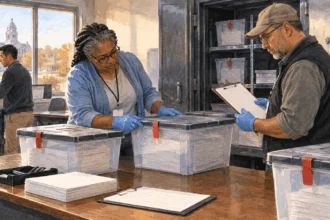
On January 28, 2026, FBI agents in tactical gear loaded more than 700 boxes of certified 2020 ballots into vehicles outside Fulton County’s election operations center near Atlanta. They were acting under a secret court order that the public can’t see, so voters and election officials still don’t know what criminal allegations were offered to justify seizing materials that have already been audited, recounted, and certified by Georgia officials.
The warrant itself, approved by federal Magistrate Judge Catherine M. Salinas, is the legal foundation for something that has never happened before in American history: no prior instance exists of federal agents executing a search warrant specifically to seize original, certified ballots from a county election office.
- How Sealed Warrants Work
- Fourth Amendment Protections for Government-Held Election Materials
- The Probable Cause Problem
- Evidence Handling and Chain of Custody
- Historical Precedent for Federal Seizure of Election Materials
- Fulton County’s Legal Options Under Rule 41(g)
- The Transparency Problem With Sealed Warrants
- What Happens Next
- The Federalism Question at the Heart of This Case
- The Stakes for 2026 and Beyond
Fulton County filed a motion on February 4 demanding the return of its election materials and seeking to unseal the warrant. That motion will determine whether those materials must be returned, and could set rules for federal intervention in election administration before the 2026 midterm elections, when control of Congress is at stake.
How Sealed Warrants Work
Federal law requires that any warrant be issued “upon probable cause, supported by Oath or affirmation, and particularly describing the place to be searched, and the persons or things to be seized.” These rules come from the Constitution’s protection against unfair searches.
Federal law doesn’t address whether warrants can be sealed, or under what circumstances. That’s decided by court decisions over time balancing First Amendment rights of public access against law enforcement interests in protecting ongoing investigations.
When law enforcement seeks a “sealed warrant,” both the search order and prosecutors’ explanation typically remain under seal, meaning neither is available for public inspection. This protects law enforcement from revealing investigative techniques, the identity of confidential sources, and the specific facts that led prosecutors to believe a search would uncover evidence of a crime.
The Supreme Court says the public generally has a right to see court records, including search warrant materials. But courts also recognize that law enforcement has legitimate interests in keeping certain information secret when disclosure would compromise investigations or endanger witnesses. Generally, courts only allow secrecy when the government has a strong reason and keeps the secrecy as limited as possible.
Different federal courts apply different rules. Some courts are stricter about requiring disclosure than others.
What makes the Fulton County warrant’s sealing potentially contentious is a basic question: do legitimate law enforcement interests require protecting sources or witnesses when investigating allegations about certified, publicly-discussed, repeatedly-audited election results? The warrant hasn’t been made public, making it impossible to evaluate whether it contains genuine allegations of federal crimes or merely rehashes previously-debunked claims.
This lack of transparency creates the scenario that the principle of public court records is designed to prevent: government action taken behind closed doors, with the public unable to hold courts or government accountable for whether the action was justified.
Fourth Amendment Protections for Government-Held Election Materials
The Fourth Amendment’s protection against “unreasonable searches and seizures” forms the constitutional foundation for evaluating whether the FBI’s seizure was lawful. The Supreme Court has never definitively ruled on whether voters, election officials, or election administrators have a legitimate reason to expect their materials won’t be searched in certified election records maintained in government facilities.
A key Supreme Court ruling says a search happens when the government violates someone’s privacy in a way society thinks is reasonable—determined by asking whether the person has a subjective expectation of privacy and whether society would recognize that expectation as reasonable.
Applying this test to government-held election records raises questions about who has the legal right to challenge the search in those materials and what constitutes a “reasonable expectation of privacy” when documents are held by government officials.
Typically, the person whose property was seized can challenge a search. But election officials don’t own the ballots—they’re holding them for the public. This creates an unfair situation: no one may have the legal right to challenge the seizure.
Georgia state law may provide an alternative basis for challenging the seizure that sidesteps federal standing doctrine entirely. Georgia law requires certified ballots to stay sealed and in election officials’ custody, with records of who handled them. If ballots were removed from Georgia’s custody without following Georgia’s procedures for unsealing them, that could raise a question under Georgia law, even if federal law permitted the seizure itself.
Federal courts can order federal law enforcement to stop violating state law when it causes permanent damage, which would clearly apply to the removal of sealed, certified ballots from state custody. This avenue has led Fulton County commissioners to emphasize that they’re not simply asking for the ballots to be returned, but specifically demanding that any materials remain under seal in Georgia’s custody, where the county can ensure their integrity and records are maintained.
Election law experts argue that certified ballots should receive special protection because they represent the final recorded choice of voters in a democratic election. Once ballots are sealed and certified, they become the foundational evidence for the legitimacy of election results, akin to evidence in a criminal case. If federal agents could seize ballots whenever federal prosecutors claimed to be investigating election fraud, the foundation of state election administration would become unstable. The Constitution gives states control over elections, which is another reason to question whether the FBI should have seized the ballots.
The Probable Cause Problem
Any search warrant requires prosecutors to establish “probable cause” to believe the search will uncover evidence of a specific federal crime. The Fulton County warrant, according to public documents, references potential violations of two federal statutes: a federal law requiring election officials to keep records, and a federal law against election fraud and intimidation.
Section 20701 requires keeping records but doesn’t say the FBI can seize them. It’s a criminal statute imposing misdemeanor penalties, up to one year in prison, for deliberately failing to keep materials.
More problematic: the legal deadline to prosecute this crime has passed. The 2020 election occurred in November 2020, meaning any allegations that election officials failed to retain materials would have had a one-year window from that date to be prosecuted—a deadline that passed by November 2021. Even if election officials had somehow destroyed or failed to retain materials (which didn’t occur, since the materials are in Fulton County’s custody), the government couldn’t prosecute them in January 2026 because the time limit had long since run.
Another law makes it a crime to commit fraud or intimidation in elections, punishable by up to five years in prison. But prosecutors would have to prove someone intentionally committed fraud or intimidation.
Evidence Handling and Chain of Custody
Once the government seizes materials, it must keep detailed records of who handled them and when. Federal law requires law enforcement to keep careful records of who handled seized materials so they can be used in court later. Federal law makes it a crime to destroy or mishandle election records. Officials who deliberately destroy or alter election records can face fines and up to ten years in prison.
Fulton County Commissioner Marvin Arrington Jr. has said the county will sue over the FBI’s seizure of its 2020 election records. Arrington, an attorney, noted that the FBI was only supposed to copy the ballots, not take the originals, which matters for how they can be used in court.
Federal law requires law enforcement to document seized evidence with photos, detailed lists, and signed receipts.
Historical Precedent for Federal Seizure of Election Materials
This appears to be the first time federal agents have seized original, certified ballots from a county election office. Courts look extra carefully at whether government actions without historical precedent are legal.
The closest example is the Voting Rights Act of 1965, which let federal authorities monitor elections in areas with histories of racial discrimination. But a 2013 Supreme Court decision ended the requirement that certain areas get federal approval before changing voting rules.
Other sealed warrant cases show how courts eventually make them public. The most prominent recent example is the August 2022 search of Mar-a-Lago to recover classified documents kept by former President Trump. That warrant was initially sealed, but after Trump publicly confirmed the search had occurred, the government asked the court to make it public. The judge agreed to unseal it, deciding the public’s right to know outweighed the government’s need for secrecy. The prosecutors’ explanation was eventually released with sensitive details removed.
A key 1952 Supreme Court decision says courts must carefully check whether the government has the power to take unusual actions. In that case, the Court said the president couldn’t seize property without Congress giving him that power. While that case involved presidential rather than prosecutorial authority, and involved property rather than government records, the same principle applies here: when government does something without precedent, courts need to see clear legal authority for it.
Fulton County’s Legal Options Under Rule 41(g)
When federal law enforcement seizes property, the owner can use several legal tools to challenge the seizure and get it back. The most direct way is a federal rule that lets people ask a court to return seized property if the search was illegal.
To win, Fulton County must prove either the search was illegal or that ballots shouldn’t be seized under federal law. Fulton County has several arguments to advance. First, the county can argue that election officials, as guardians of the ballots, can challenge the seizure on behalf of the public. Second, the county can argue the warrant shouldn’t have been issued because there’s no evidence of a federal crime—the time limit to prosecute has passed, no specific person’s wrongdoing was identified, and the allegations have already been rejected by courts. Third, the county can argue that taking the ballots violated Georgia law, which requires them to stay sealed and in election officials’ hands. Fourth, the county can argue that the FBI didn’t keep proper records of who handled the ballots, so we can’t know if they were changed.
The government would likely argue the search was legal because a judge approved it and the ballots are evidence related to the warrant. But the government must prove it still needs the ballots for an active criminal investigation. Federal law gives the government 90 days to decide whether to file criminal charges, start an investigation, or ask for more time.
Fulton County filed its motion seeking return of the materials on February 4, 2026, meaning the government has until early May 2026 to file charges or ask for more time. Since no charges have been filed in five years and none seem likely, the government’s reason for keeping the ballots gets weaker each month.
The county also wants the court to make public the prosecutors’ explanation so people can judge whether the search was justified. Courts generally favor making warrants public once the investigation is advanced enough or when the public’s right to know matters more than law enforcement secrecy.
The Transparency Problem With Sealed Warrants
When law enforcement uses a sealed warrant, the public can’t see the government’s reasons, whether the allegations are real, or whether the search was legitimate. That problem applies in the Fulton County case.
Without seeing the prosecutors’ explanation, voters and officials can’t tell whether the government’s reasons hold up. In the Fulton County case, the allegations involve publicly discussed claims about a certified election, and the investigation involves public officials.
What Happens Next
Fulton County’s request to get the ballots back is pending in federal court in Georgia. The court might take weeks or months to decide, depending on the court’s schedule and case complexity.
If the court rules against Fulton County, it can appeal to a higher court and potentially ask the Supreme Court to review the case. If the court rules in Fulton County’s favor, the government can appeal.
Fulton County’s request to unseal the warrant might be decided separately from the request to get the ballots back. Legal experts expect the warrant will eventually be made public, either because a court orders it or because charges are filed. But it could take six months to a year, depending on the court’s schedule and whether the government appeals.
The broader question of whether federal prosecutors can use criminal investigations to take over state elections will likely reach higher courts and possibly the Supreme Court. If higher courts rule against the government, it would mean federal law enforcement can’t seize election materials based on claims courts have already rejected. If courts uphold the seizure, federal agents could take over state elections whenever prosecutors claim to be investigating fraud—a major shift in power from states to the federal government.
A court might rule within three to six months, though appeals could take much longer. If the government can’t show it needs the ballots for an active criminal investigation, the court should order them returned. What’s clear is that by November 2026, the Fulton County case will likely still be in court, so the legal question won’t be settled before the midterms.
The Federalism Question at the Heart of This Case
At the core is a basic question: who should control elections—the federal government or the states? The Constitution gives states primary power over federal elections, unless Congress passes new laws. The Framers designed it this way because they feared that centralizing election power would let those in power rig elections for themselves.
The Trump administration has said it wants to take control of elections in at least 15 states, according to published reports. Courts have already blocked multiple attempts by the Trump administration to change state election rules through presidential orders.
If federal prosecutors can seize state election materials based on old claims and use that to take control of elections, it would bypass constitutional limits on federal power. If courts protect state control over elections by ordering the ballots returned and limiting federal investigations, they maintain the constitutional division of power between states and the federal government.
Federal authorities have the power to investigate voter fraud and election crimes. What sets this search apart is its target: election results that have been certified, audited, and recounted multiple times. A sealed warrant also leaves the public unable to judge the evidence behind it, which can undermine confidence in the justice system.
The Stakes for 2026 and Beyond
As of February 2026, with the midterms nine months away, the courts haven’t decided the Fulton County case. Courts will decide three things: whether federal law enforcement can seize state election materials, what protections apply to those materials, and what remedies exist if federal agents exceed their authority. These decisions will affect the federal government’s authority over elections for years to come.